
What Is Email Connectivity in Purchaser?
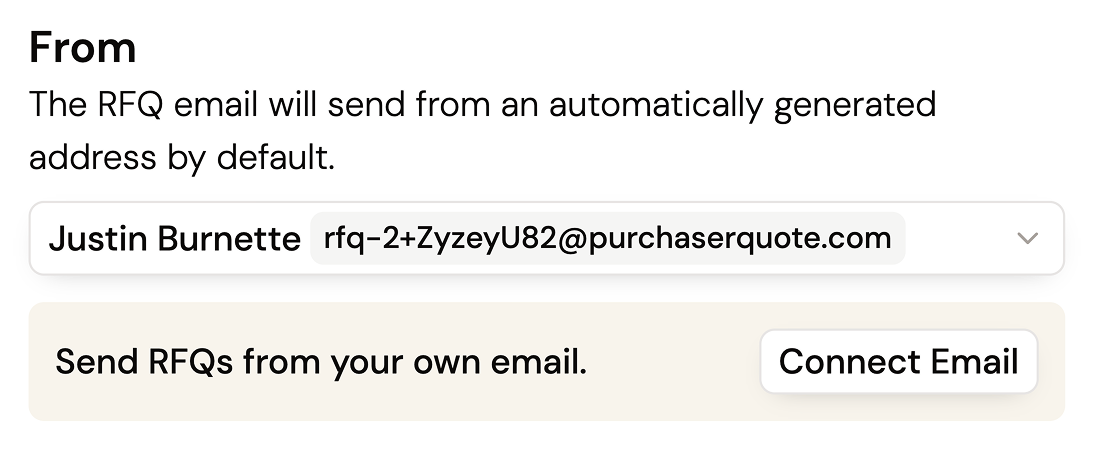
Email connectivity allows procurement teams to send RFQs from their own work email addresses directly through Purchaser, instead of from system-generated addresses. Suppliers see a familiar sender, which preserves existing relationships and increases response rates.
| Term | Definition |
|---|---|
| Email connectivity | The ability to link a work email account (Gmail or Outlook) to Purchaser so RFQs are sent from that address |
| RFQ (Request for Quotation) | A structured solicitation sent to vendors requesting pricing and scope details for a defined scope of work |
| Metadata-only access | A security model where Purchaser reads only email metadata (sender, subject, date) and never accesses email body content unless the email is a direct RFQ response |
| SOC 2 compliance | An auditing standard that certifies a platform meets strict requirements for data security, availability, and confidentiality |
| OAuth authentication | A secure authorization protocol that lets Purchaser connect to an email provider without storing the user’s password |
Why Work Email Matters for RFQ Response Rates
When Purchaser launched its RFQ feature, procurement teams raised a consistent concern: RFQs sent from auto-generated email addresses were treated differently by suppliers. Supplier relationships are built on trust and recognition. An RFQ arriving from a known work email address signals legitimacy and priority.
| RFQ Delivery Method | Supplier Recognition | Response Priority | Relationship Continuity |
|---|---|---|---|
| Auto-generated email address | Low — unfamiliar sender | Lower — may be filtered or deprioritized | Disrupted — supplier cannot connect request to existing contact |
| Connected work email | High — recognized sender | Higher — treated as direct communication | Preserved — existing relationship carries forward |
Purchaser now sends RFQs from the user’s own work email, automatically routing supplier responses back into the platform. The sender’s identity and reputation remain intact throughout the sourcing process.
Key Takeaway: Email connectivity eliminates the tradeoff between using a structured procurement platform and maintaining direct supplier relationships.
How to Connect Your Work Email: Step-by-Step Setup
Connecting a work email requires four steps within the RFQ workflow:
- Draft an RFQ — Create a new RFQ in Purchaser and click Next Step.
- Initiate email connection — Below the subject line, the current sender email is displayed. Click Connect Your Email.
- Select your email provider — Choose Gmail or Outlook. These are the two providers currently supported.
- Authenticate with your provider — Purchaser redirects to your email provider’s OAuth flow. Re-authenticate and grant Purchaser permission to send on your behalf.
Once connected, Purchaser automatically sends all future RFQs from your work email and routes supplier responses back into the platform for structured tracking.
Key Takeaway: Setup takes under two minutes, requires no IT involvement, and uses your email provider’s own authentication—no passwords are stored by Purchaser.
How Email Connectivity Works
Purchaser integrates directly with Gmail and Outlook using OAuth-based authentication. After a user grants permission, the platform operates as follows:
- Outbound RFQs — Purchaser sends RFQs from the connected work email address. Suppliers receive the message as if it were sent directly from the user’s inbox.
- Inbound response detection — When the email provider notifies Purchaser of a new inbound email, Purchaser reads only the metadata (sender, subject, date) to determine whether the email is a response to a Purchaser-originated RFQ.
- Selective content access — If the email matches an active RFQ, Purchaser retrieves the email body and attaches it to the corresponding RFQ record. If the email is unrelated to a Purchaser RFQ, the body is never requested or accessed.
| Processing Stage | What Purchaser Accesses | What Remains Private |
|---|---|---|
| Inbound email notification | Metadata only (sender, subject, date) | Email body, attachments |
| RFQ-related email detected | Full email content for that specific message | All other emails |
| Non-RFQ email detected | Nothing beyond initial metadata check | Full email content, attachments |
Key Takeaway: Purchaser applies a metadata-first approach that limits data access to RFQ-related messages only, keeping all other work communications private.
Security Architecture for Email Connectivity
Purchaser processes all email data within its own SOC 2-certified infrastructure. No third-party systems are used to connect to email providers or store email content.
No third-party intermediaries — The connection between Purchaser and Gmail or Outlook is direct. Email data never passes through external services.
Metadata-only default — Purchaser requests email body content only when the metadata matches an active RFQ. All other emails are ignored after the metadata check.
SOC 2-certified infrastructure — All email processing, storage, and routing occurs within Purchaser’s audited environment. Data protection policies are published at trust.purchaser.ai.
OAuth-based authentication — User credentials are never stored. Authentication is handled entirely by the email provider’s OAuth flow.
| Security Property | Implementation |
|---|---|
| Data residency | All email data processed and stored within Purchaser’s SOC 2-certified infrastructure |
| Third-party data sharing | None — no external systems access email data |
| Credential storage | None — OAuth tokens are used; passwords are never stored |
| Email body access | Only for emails matching an active Purchaser-originated RFQ |
| Audit trail | Full data protection policies available at trust.purchaser.ai |
Key Takeaway: Email connectivity is designed so that Purchaser accesses the minimum data necessary and processes it entirely within its own audited infrastructure.
Plan Availability
Email connectivity is available on the Professional and Enterprise plans.
- Start using the feature now at https://app.purchaser.ai/rfqs
- Schedule a demo at https://purchaser.ai/book-a-demo
Frequently Asked Questions
Which email providers does Purchaser support for email connectivity? Purchaser currently supports Gmail and Outlook. These two providers cover the majority of enterprise work email environments.
Does Purchaser store my email password? No. Purchaser uses OAuth-based authentication, which means your email provider handles the login process. Purchaser receives a secure token to send on your behalf—your password is never transmitted to or stored by Purchaser.
Will Purchaser read all of my emails? No. Purchaser reads only the metadata (sender, subject, date) of inbound emails to check whether they are responses to Purchaser-originated RFQs. Email body content is accessed only for confirmed RFQ responses. All other emails are ignored after the metadata check.
What happens if I disconnect my email? RFQs will revert to being sent from a Purchaser-generated email address. Previously sent RFQs and their associated supplier responses remain in the platform.
Is email connectivity available on all plans? No. Email connectivity is available on the Professional and Enterprise plans. Teams on other plans can upgrade or schedule a demo to learn more.
Email Connectivity Setup Checklist
- Confirm your organization is on the Professional or Enterprise plan
- Draft a new RFQ in Purchaser and navigate to the send step
- Click Connect Your Email below the subject line
- Select your email provider (Gmail or Outlook)
- Complete the OAuth authentication flow with your email provider
- Verify that your work email address is displayed as the sender on the RFQ
- Send a test RFQ and confirm the supplier receives it from your work email address