
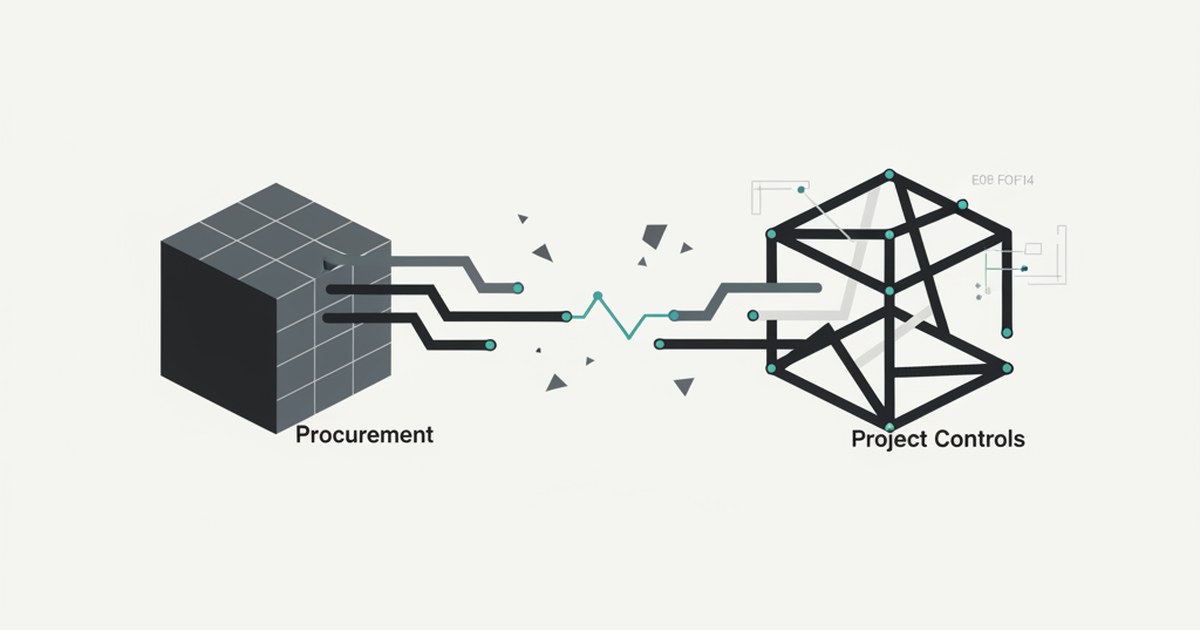
The Procurement-Project Controls Disconnect
Procurement and project controls frequently operate as separate functions with misaligned priorities. The result: schedule delays, cost overruns, and post-award disputes that could have been prevented. Closing this gap is one of the highest-leverage actions available to engineering and capital project leaders.
Key Concepts
| Term | Definition |
|---|---|
| Procurement | The function responsible for sourcing materials, equipment, and services at the required quality, cost, and schedule |
| Project Controls | The function responsible for tracking and managing project schedule, budget, and scope |
| Procurement-Project Controls Disconnect | The misalignment between procurement timelines/priorities and project schedule/cost baselines |
| KPI Alignment | The practice of defining shared performance metrics that both procurement and project controls are evaluated against |
| ADKAR Model | A change management framework: Awareness, Desire, Knowledge, Ability, Reinforcement |
Why the Disconnect Exists: Root Causes
Procurement and project controls have structurally different objectives that create tension when not explicitly coordinated.
| Function | Primary Objective | Typical Success Metric |
|---|---|---|
| Procurement | Source at lowest total cost | Unit price, savings vs. budget |
| Project Controls | Keep project on schedule and within budget | Schedule variance, cost variance |
Key Takeaway: When procurement optimizes for unit price without visibility into schedule criticality, delays in vendor selection or delivery directly translate into project cost overruns—often at a multiplier far exceeding the original savings.
How the Disconnect Manifests in Practice
- Procurement completes price negotiations while project controls flags a critical-path material as overdue
- Long-lead equipment is ordered late because procurement was not included in the project schedule baseline
- Vendor qualification cycles extend beyond schedule float, converting a manageable delay into a contract penalty
- Change orders accumulate because scope deviations in vendor quotes were not identified before award
The Cost of Siloed Operations
A construction project fails to meet a commissioning deadline because critical rotating equipment arrived six weeks late. The procurement team had prioritized achieving a lower unit price through extended negotiation; project controls had not communicated that this item sat on the critical path with zero schedule float. By the time the equipment arrived, the project had absorbed liquidated damages, demobilization and remobilization costs, and a penalty clause from the end client.
This scenario repeats across EPC, manufacturing, and infrastructure projects. The failure mode is not incompetence—it is structural: two functions with different KPIs, different tools, and no shared data layer.
Four Strategies to Bridge the Gap
1. Establish Shared KPIs
Evaluate both teams against metrics that reflect joint performance, not functional performance in isolation.
Recommended shared KPIs:
| KPI | What It Measures |
|---|---|
| Procurement Schedule Adherence | % of purchase orders issued on or before the need date from the project schedule |
| On-Time Delivery Rate | % of materials delivered by required-on-site date |
| Budget Variance at Commitment | Cost variance between estimate and awarded contract value |
| Change Order Rate | % of contracts requiring scope/cost changes post-award |
2. Integrate Procurement Milestones into the Project Schedule
Procurement activities—vendor list approval, RFQ issue, bid receipt, technical evaluation, commercial award, expediting, delivery—must appear as explicit activities in the project schedule with logic ties to downstream construction activities.
Key Takeaway: A procurement milestone in the schedule creates accountability. A procurement activity tracked only in a separate procurement register is invisible to project controls until it is too late.
3. Implement a Shared Data Layer
Real-time dashboards that surface both procurement status and project schedule metrics allow both teams to identify converging risks before they become critical.
Minimum data to share across functions:
- Required-on-site dates for all long-lead and critical-path items
- Current procurement status (RFQ issued, bids received, evaluation in progress, award complete)
- Vendor delivery commitments vs. required dates
- Open commercial issues that may affect delivery schedule
4. Apply Structured Change Management (ADKAR)
Behavioral change—moving from siloed operations to integrated workflows—requires explicit change management investment.
| ADKAR Stage | Applied Action |
|---|---|
| Awareness | Quantify the cost of disconnects using historical project data |
| Desire | Align leadership incentives around shared project outcomes |
| Knowledge | Train both teams on each function’s constraints and dependencies |
| Ability | Provide shared tools and regular cross-functional review cadences |
| Reinforcement | Report shared KPIs to project leadership; recognize cross-functional wins |
Measurable Outcomes from Alignment
Organizations that integrate procurement and project controls report:
- Fewer late deliveries of critical-path materials
- Reduced change order frequency (scope deviations caught pre-award, not post-award)
- Lower total project cost (schedule compression from delays is typically more expensive than unit price variance)
- Improved stakeholder satisfaction through predictable project delivery
Frequently Asked Questions
Q: Who owns the procurement schedule—procurement or project controls? A: Procurement owns execution (vendor engagement, negotiation, award). Project controls owns the schedule baseline and float analysis. Both must own the interface: procurement milestones should be baselined in the project schedule with input from both functions.
Q: What is the most common first step for organizations with a significant disconnect? A: Establish a joint weekly procurement-project controls review meeting focused on critical-path and long-lead items. Shared visibility is the prerequisite for all other improvements.
Q: How does procurement software help close this gap? A: Modern procurement platforms like Purchaser surface vendor submission status, scope deviations, and delivery commitments in a structured format—eliminating the manual effort required to compile procurement status reports and making the data available in real time to project controls.
Q: Can KPI alignment create conflict if teams are evaluated differently by their own management? A: Yes—this is a common implementation failure. Shared KPIs require executive sponsorship and must be reflected in individual performance reviews, not just project dashboards, to change behavior sustainably.