
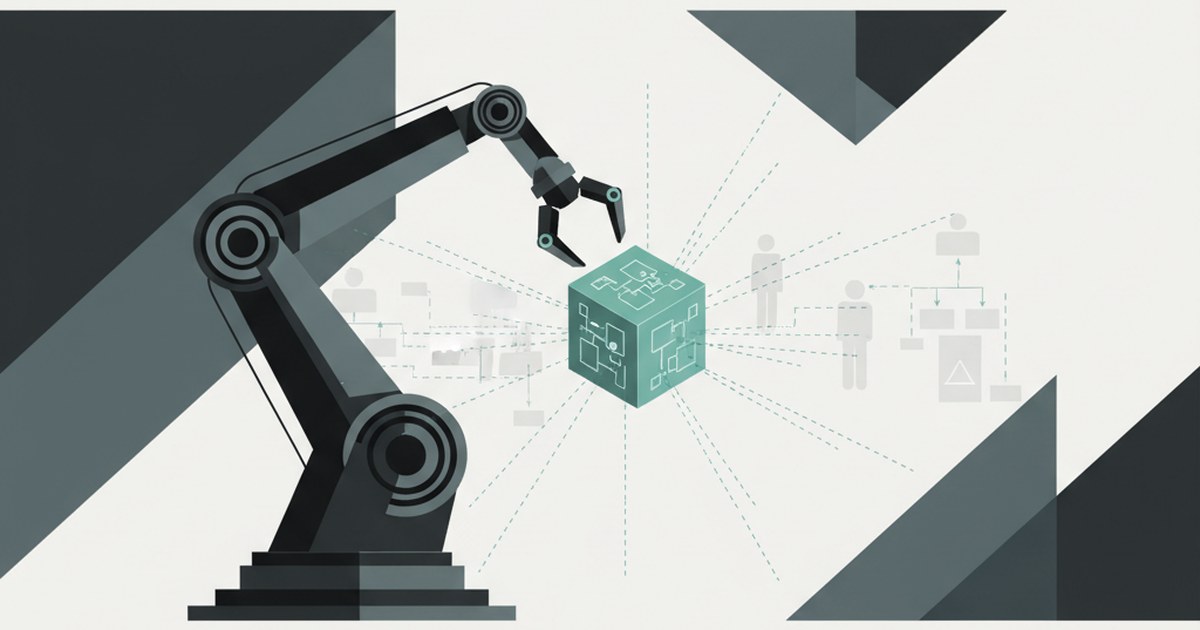
The Shift From AI-Assisted Decisions to AI-Owned Outcomes
AI in procurement, supply chain, and operations is shifting from a decision-support role to an outcome-ownership role. For years, AI functioned as an assistant—processing data, generating forecasts, and surfacing recommendations for human operators to act on. Today, advanced AI systems execute end-to-end processes: selecting suppliers, adjusting inventory levels, and routing shipments based on real-time data without waiting for human approval.
This transition raises concrete questions about accountability, organizational readiness, and how to maintain human oversight when AI controls operational outcomes.
| Term | Definition |
|---|---|
| Decision-support AI | AI that analyzes data and presents recommendations for human operators to review and act on |
| Outcome-ownership AI | AI that executes decisions end-to-end, controlling process outcomes directly based on predefined parameters and learned patterns |
| Machine learning | Algorithms that learn from historical data, identify patterns, and improve decision accuracy over time without explicit reprogramming |
| Accountability framework | A defined set of policies specifying who is responsible for outcomes when AI systems make operational decisions |
| Hybrid oversight model | An operating model where AI handles structured, repeatable decisions while humans retain authority over high-context or high-risk decisions |
How AI Currently Operates in Procurement and Supply Chain
In its decision-support role, AI performs three primary functions in procurement and supply chain operations:
- Demand forecasting — Processing historical purchasing data to predict future inventory needs
- Supplier performance analysis — Aggregating delivery timeliness, cost variance, and quality metrics into scorecards
- Inventory optimization — Calculating reorder points and safety stock levels based on demand signals and lead times
These functions accelerate analysis that would take human operators significantly longer. However, the human operator reviews the output and makes the final decision.
Advanced AI systems go further. They automatically switch suppliers when performance metrics fall below thresholds, dynamically adjust inventory levels using predictive analytics, and reroute shipments based on real-time logistics data. In these cases, AI is not presenting options—it is executing decisions.
Key Takeaway: The distinction between decision-support AI and outcome-ownership AI is whether a human operator reviews and approves the output before it is executed. Outcome-ownership AI acts on its own within defined parameters.
How Machine Learning Enables Outcome Ownership
Machine learning is the core technology enabling AI to move from support to ownership. Machine learning algorithms train on historical data—past supplier performance, delivery outcomes, pricing trends—and identify patterns that predict future results. Over time, these algorithms improve their accuracy without requiring manual rule updates.
Example: Route optimization in logistics. A logistics provider deploys an AI system to optimize delivery routes. The system analyzes traffic patterns, weather data, and historical delivery times. After processing thousands of deliveries, the system learns to predict delays caused by local conditions—seasonal road closures, recurring congestion windows, weather-related disruptions. The system then reroutes shipments proactively, reducing late deliveries by a measurable percentage.
In this case, the AI is not recommending route changes for a human dispatcher to approve. It is making and executing route decisions in real time. The dispatcher monitors exceptions rather than approving each decision.
Example: Supplier switching based on performance data. A procurement system monitors supplier KPIs—on-time delivery rate, defect rate, and cost per unit. When a supplier’s rolling 90-day performance drops below a defined threshold, the system automatically redirects new purchase orders to the next-ranked supplier. The procurement team reviews the switch after it occurs, rather than approving it in advance.
Key Takeaway: Machine learning enables outcome ownership by allowing AI systems to learn from historical data, adapt to changing conditions, and execute decisions within human-defined parameters—without requiring approval for each individual action.
Defining Accountability When AI Owns Outcomes
When AI executes decisions directly, accountability becomes more complex. If an AI system selects a supplier that delivers defective components, the resulting costs and delays require a clear chain of responsibility.
Three accountability questions arise when AI owns outcomes:
- Who defined the parameters? — The team that configured the AI’s decision rules (thresholds, scoring weights, override conditions) is accountable for the scope of AI authority.
- Who monitored performance? — The team responsible for reviewing AI outputs and exception reports is accountable for catching systematic errors.
- Who approved the deployment? — The leadership that authorized AI outcome ownership for a given process is accountable for the organizational risk.
Organizations that operate AI in an outcome-ownership role need an accountability framework that specifies these responsibilities. Without one, failures default to ambiguous blame between the technology provider, the procurement team, and operations leadership.
A hybrid oversight model addresses this by categorizing decisions into tiers:
| Decision Tier | AI Authority | Human Involvement | Example |
|---|---|---|---|
| Fully automated | AI executes without approval | Human reviews exception reports | Restocking standard components at threshold |
| AI-recommended, human-approved | AI generates recommendation | Human approves before execution | Selecting a new supplier for a critical category |
| Human-led, AI-supported | Human makes decision | AI provides data and analysis | Negotiating a multi-year supply agreement |
Key Takeaway: Accountability for AI-owned outcomes requires a defined framework that assigns responsibility for parameter setting, performance monitoring, and deployment authorization. A tiered decision model clarifies where AI acts independently and where human approval is required.
Measuring the Business Impact of AI Outcome Ownership
AI outcome ownership produces measurable business results when applied to the right processes. The impact shows up in specific operational KPIs:
- Reduced downtime — AI-driven predictive maintenance forecasts equipment failures before they occur. A manufacturing firm using predictive maintenance can reduce unplanned downtime, lowering operational costs and increasing production output.
- Improved inventory turns — AI that automatically adjusts stock levels based on demand predictions reduces both stockouts and excess inventory. Procurement teams spend less time on emergency orders and write-offs.
- Faster supplier response — AI systems that automatically evaluate and redirect purchase orders based on supplier performance reduce the time between identifying a supplier issue and resolving it.
- Lower procurement cycle time — Automating supplier selection, quote comparison, and purchase order generation for routine categories compresses the end-to-end procurement cycle.
Organizations that delay adopting outcome-ownership AI for routine processes face a competitive disadvantage. Teams that still manually review every reorder, route decision, and supplier scorecard operate at a slower pace and higher cost than teams where AI handles these tasks automatically.
Key Takeaway: AI outcome ownership delivers measurable improvements in downtime reduction, inventory efficiency, supplier response time, and procurement cycle time—specifically for structured, repeatable processes where the decision criteria are well-defined.
Building a Strategy for AI Outcome Ownership
Transitioning from decision-support AI to outcome-ownership AI requires a deliberate, phased approach. The following steps provide a framework for procurement, supply chain, and operations leaders:
- Evaluate current AI capabilities — Assess which AI tools your organization uses today and whether they operate in a decision-support or outcome-ownership role. Identify processes where AI could take on more responsibility based on decision complexity and risk level.
- Define an accountability framework — Establish clear policies for who is responsible when AI makes decisions. Specify parameter-setting authority, monitoring responsibilities, and escalation paths for AI-driven outcomes.
- Invest in team training — Equip procurement and operations teams with the skills to monitor AI performance, interpret exception reports, and override AI decisions when conditions change. Training should cover data interpretation and structured decision-making for edge cases.
- Monitor outcomes and calibrate — Track KPIs for AI-managed processes against human-managed baselines. Use the data to expand AI authority where it outperforms manual processes and pull it back where it underperforms.
- Align stakeholders on AI’s role — Communicate the scope and limits of AI decision-making to all stakeholders—procurement, operations, finance, and leadership. A shared understanding of what AI controls and what humans control prevents organizational friction.
Key Takeaway: The transition to AI outcome ownership is a phased process that requires capability assessment, accountability definition, team training, outcome monitoring, and stakeholder alignment. Organizations that skip these steps risk deploying AI without the governance structures needed to manage it effectively.
Comparing Decision-Support AI and Outcome-Ownership AI
| Dimension | Decision-Support AI | Outcome-Ownership AI |
|---|---|---|
| Human involvement | Reviews and approves every recommendation | Monitors exceptions and performance trends |
| Speed of execution | Limited by human review cycle | Executes in real time within defined parameters |
| Accountability model | Human operator owns the decision | Shared across parameter-setters, monitors, and deployers |
| Best suited for | High-context, high-risk decisions | Structured, repeatable, well-defined processes |
| Risk profile | Lower (human validates each output) | Higher (errors propagate before human review) |
| Organizational readiness required | Moderate (tools and basic training) | High (accountability framework, monitoring, training) |
Frequently Asked Questions
What is the difference between decision-support AI and outcome-ownership AI? Decision-support AI analyzes data and presents recommendations for a human operator to review and approve before execution. Outcome-ownership AI executes decisions end-to-end within predefined parameters, without requiring human approval for each action. The human role shifts from approving individual decisions to setting parameters and monitoring aggregate performance.
How do organizations maintain accountability when AI makes operational decisions? Organizations define an accountability framework that assigns responsibility across three roles: the team that sets AI decision parameters, the team that monitors AI performance and exception reports, and the leadership that authorizes AI outcome ownership for specific processes. This framework ensures that every AI-driven decision has a clear chain of human accountability.
Which procurement processes are best suited for AI outcome ownership? Structured, repeatable processes with well-defined decision criteria—such as routine inventory reorders, standard supplier scoring, and purchase order routing based on pre-approved rules. Processes that require contextual judgment, relationship assessment, or negotiation (e.g., strategic supplier selection, contract negotiation) should remain human-led with AI providing data support.
What are the risks of deploying AI in an outcome-ownership role? The primary risk is error propagation: when AI executes decisions without human review, an incorrect decision can compound before it is detected. Mitigations include tiered decision authority (limiting full automation to lower-risk processes), real-time monitoring dashboards, and structured exception reporting that flags anomalies for human review.
How should teams prepare for the transition from decision-support to outcome-ownership AI? Teams need training in three areas: monitoring AI performance metrics, interpreting exception reports to identify systematic errors, and applying structured decision-making frameworks when overriding AI recommendations. The transition should be phased—starting with a pilot in a limited scope, measuring results against human-managed baselines, and expanding AI authority based on demonstrated performance.