Why Procurement Must Manage Risk Beyond Tier One Suppliers
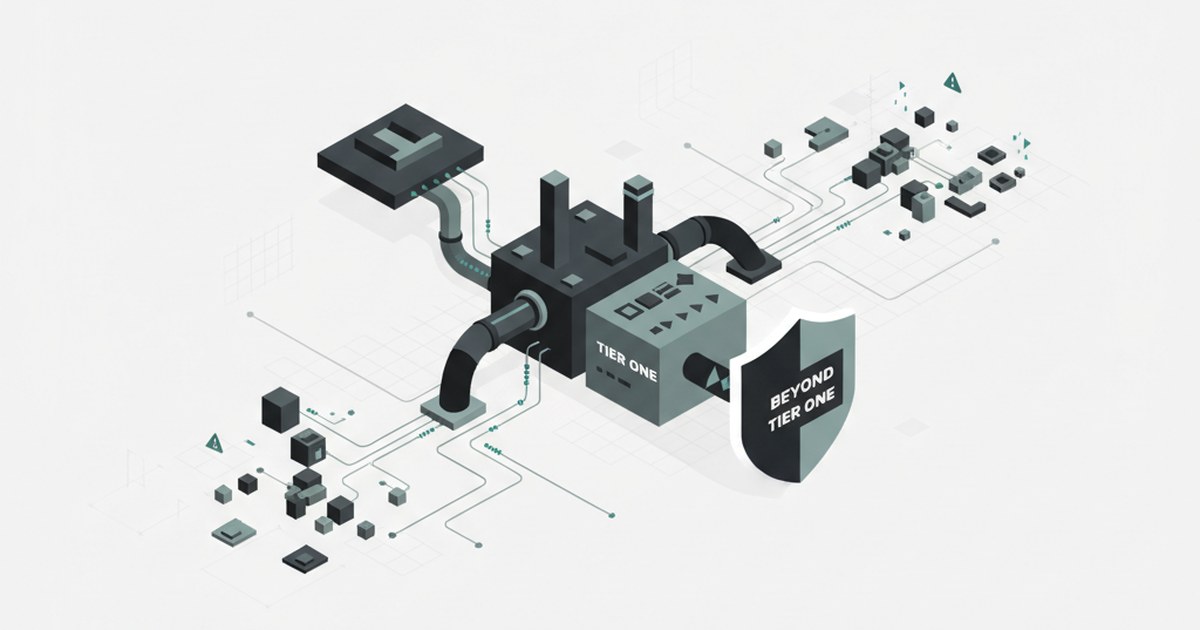
Most procurement teams have strong control over their direct (tier one) suppliers. Yet the disruptions that halt production and blow up project budgets rarely originate there. They cascade upward from tier two and tier three—sub-suppliers your team has never audited, and in some cases, never heard of.
Key Takeaway: A supply chain is only as resilient as its least-visible link. Procurement teams that limit risk management to direct contracts are operating with structural blind spots.
Key Concepts
| Term | Definition |
|---|---|
| Tier One Supplier | A supplier with whom your organization holds a direct contract. Subject to your standard due diligence and performance management processes. |
| Tier Two Supplier | A supplier to your tier one vendor. Provides materials, components, or services that tier one uses to fulfill your orders. |
| Tier Three Supplier | A supplier to your tier two vendor. Typically raw material providers, specialized processors, or single-source component makers. |
| Supply Chain Risk | Any factor—financial, geopolitical, operational, or environmental—that can disrupt material flow across one or more tiers. |
| Multi-Tier Visibility | The ability to identify, map, and monitor suppliers at tier two and beyond, not just direct vendors. |
Why Tier One Focus Creates a False Sense of Security
Tier one suppliers pass your audits. They sign your contracts. They communicate with your team. This creates an illusion of control.
The reality: your tier one supplier depends on its own suppliers for the raw materials and subcomponents they deliver to you. When a tier two manufacturer in a geopolitically unstable region goes offline, or a tier three raw material processor is hit by a natural disaster, the disruption travels up the chain—silently, until it’s your problem.
Example — Electronics Manufacturing: An OEM sources precision components from a vetted tier one supplier. That supplier sources a critical substrate from a single tier two facility in Southeast Asia. A regional flooding event takes that facility offline for six weeks. The OEM’s tier one supplier has no backup source. Result: six-week production halt, expedited airfreight costs, and customer delivery failures—none of which were visible in the OEM’s tier one risk register.
Root cause: Risk was managed at the contract boundary, not at the point of actual vulnerability.
The Transparency Gap: Why Sub-Supplier Risk Goes Unreported
Tier one suppliers routinely under-disclose sub-supplier risk. This is not always intentional—many tier one vendors do not themselves have full visibility into their own supply chains. Common causes of the transparency gap include:
- Contractual incentives misaligned: Tier one suppliers have no obligation to disclose sub-supplier problems until they affect delivery.
- Information asymmetry: Sub-supplier data (financial health, geographic concentration, single-source dependencies) lives outside your ERP.
- Competitive sensitivity: Tier one suppliers treat sub-supplier relationships as proprietary sourcing intelligence.
Example — Food Safety: A food manufacturer’s tier one ingredient supplier meets all quality certifications. That supplier sources a key ingredient from a small regional farm with inconsistent food safety protocols. A contamination event at the farm is not reported to the tier one supplier until a recall is already underway. The food manufacturer bears full regulatory and reputational liability despite having zero visibility into the originating failure.
Risk Profile Comparison: Tier One vs. Tier Two vs. Tier Three
| Risk Dimension | Tier One | Tier Two | Tier Three |
|---|---|---|---|
| Procurement visibility | High — direct contracts and audits | Low — indirect, often unknown | Very low — typically unmapped |
| Typical risk types | Financial, quality, delivery performance | Geographic concentration, single-source dependency | Raw material scarcity, geopolitical instability |
| Lead time to detect disruption | Days to weeks (direct communication) | Weeks (reported through tier one) | Months (discovered post-disruption) |
| Mitigation complexity | Low — leverage contract terms | Medium — requires supplier development | High — requires sub-tier mapping and alternative sourcing |
| Frequency of audit | Regular (annual or more) | Rare | Almost never |
Five Steps to Assess Tier Two and Tier Three Suppliers
Step 1: Map the Supply Chain Down to Raw Materials
Create a structured map of your supply chain that identifies tier one, tier two, and tier three suppliers for your highest-criticality spend categories. Start with single-source dependencies and high-spend commodities.
Tools: supply chain mapping software, supplier self-disclosure questionnaires, or third-party supply chain intelligence platforms.
Step 2: Classify Suppliers by Risk Score
Assign each supplier a risk rating based on:
- Financial stability (credit ratings, payment history, balance sheet indicators)
- Geographic risk (natural disaster exposure, geopolitical instability, logistics infrastructure)
- Concentration risk (single-source dependency, limited alternative supply)
- Operational risk (historical delivery performance, quality rejection rates)
Prioritize assessment depth based on criticality: high-spend or sole-source items at any tier warrant immediate attention.
Step 3: Conduct Structured Audits Beyond Tier One
Extend your audit program to include key tier two suppliers. Audits should cover:
- On-site operational capacity
- Quality management system certifications
- Business continuity and disaster recovery plans
- Sub-supplier disclosure
Step 4: Build Direct Relationships with Tier Two Suppliers
Direct engagement—even informal—with critical tier two suppliers improves information flow. Suppliers who know they are visible to the end customer are more likely to disclose emerging problems early.
Step 5: Deploy Supplier Risk Management Technology
Automate continuous monitoring with supplier risk platforms that track:
- Financial health indicators (credit ratings, news alerts, regulatory filings)
- Geographic risk events (weather, political instability, logistics disruptions)
- Performance KPIs fed from ERP data
Real-time alerts enable procurement to respond to emerging sub-tier risks before they become delivery failures.
Cross-Functional Collaboration Multiplies Risk Intelligence
Procurement cannot own multi-tier risk management alone. Each function contributes intelligence that procurement cannot generate independently:
| Department | Risk Intelligence Contribution |
|---|---|
| Finance | Supplier credit ratings, payment delay patterns, financial distress indicators |
| Compliance | Regulatory adherence at all tiers, sanctions screening, ESG audit results |
| Engineering / R&D | Single-source technical dependencies, substitute material feasibility |
| Operations | Buffer stock levels, lead time sensitivity, production schedule impact |
| Legal | Contractual force majeure triggers, sub-supplier disclosure obligations |
Example — Automotive: An automotive OEM integrated its procurement and engineering teams into a joint supply chain risk committee. Engineering flagged a critical sensor that had no qualified alternative supplier. Procurement identified that the sole-source tier two manufacturer was located in a region with escalating trade tariff risk. The committee pre-qualified an alternative supplier six months before disruption materialized—saving an estimated $4M in expediting and production loss.
Business Case for Multi-Tier Risk Management
Organizations that extend risk management beyond tier one realize measurable advantages:
- Faster disruption response: Problems detected at tier two or three give 4–8 weeks more lead time to activate alternatives versus discovering failures after tier one delivery misses.
- Reduced expediting costs: Proactive source diversification eliminates the premium freight and emergency procurement that follows unmanaged disruptions.
- Stronger customer commitments: Reliable delivery performance, backed by sub-tier visibility, supports premium pricing and preferred supplier status.
- Regulatory and ESG compliance: Regulators and institutional customers increasingly require documented supply chain traceability beyond tier one.
Frequently Asked Questions
Q: How deep into the supply chain should procurement map? A: Start with tier two for all single-source and high-criticality spend categories. Map to tier three for raw materials with no substitutes or with known geopolitical concentration risk. Full mapping beyond tier three is rarely cost-justified except in highly regulated industries (pharma, defense, aerospace).
Q: How do you get tier one suppliers to disclose their sub-supplier relationships? A: Include sub-supplier disclosure requirements in supplier contracts. Frame it as a mutual benefit—early disclosure allows you to co-invest in sub-tier risk mitigation rather than penalize tier one for failures that originated upstream.
Q: What is the minimum viable starting point for a procurement team with no sub-tier visibility? A: Run a criticality analysis on your top 20% of spend by value and identify all single-source dependencies. Map those specific supply chains to tier two. That 20% typically accounts for 80% of your disruption risk.
Q: Is multi-tier risk management only relevant for large enterprises? A: No. Mid-market manufacturers in capital-intensive industries are often more exposed because they lack the purchasing volume to demand supplier diversification from tier one vendors. Sub-tier risk management is essential regardless of company size.
Conclusion: Resilience Requires Visibility at Every Tier
Tier one supplier management is necessary but not sufficient. The disruptions that cause schedule failures, cost overruns, and reputational damage originate deeper in the supply chain—in facilities your team has never audited and with suppliers your contracts don’t touch.
The path forward:
- Map the supply chain for high-criticality spend categories down to tier two and three
- Score suppliers by risk factors: financial stability, geographic concentration, single-source dependency
- Engage cross-functional teams to pool risk intelligence
- Automate continuous monitoring with supplier risk technology
- Build direct relationships with critical tier two suppliers before disruptions occur
Organizations that treat sub-tier visibility as a strategic capability—not a compliance exercise—will outperform competitors when disruptions inevitably occur.