
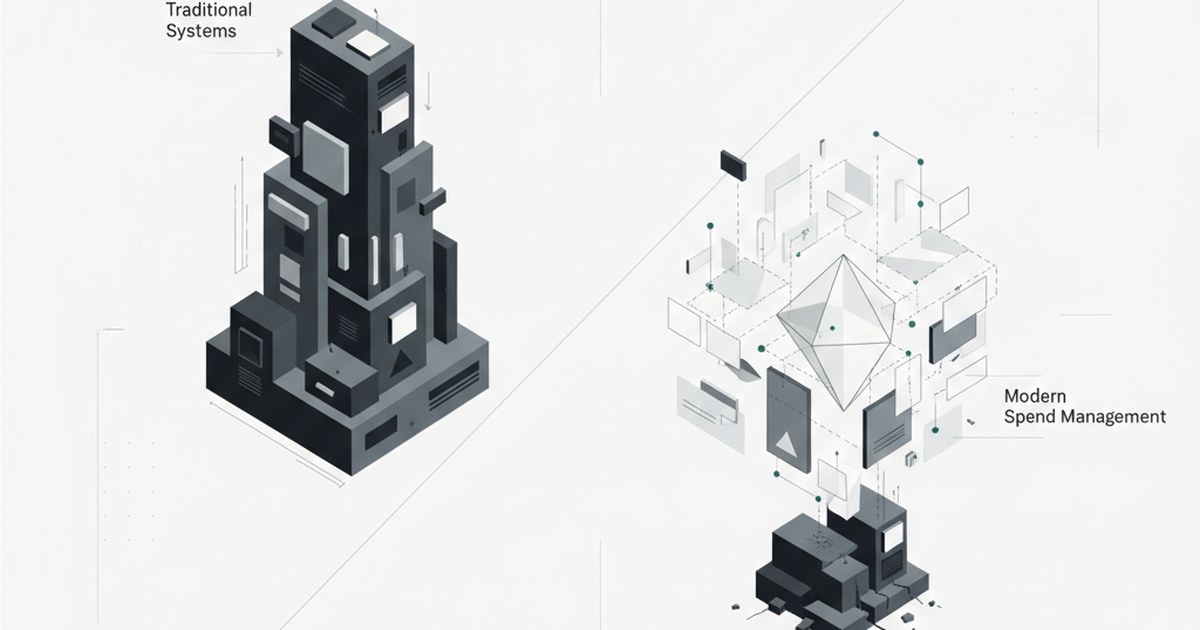
Why Traditional Systems Can’t Keep Up With Modern Spend Management
Organizations that still manage procurement spend through legacy ERP modules, spreadsheets, and manual approval workflows are operating with a structural disadvantage. The gap between what legacy systems provide and what modern spend management requires is widening—driven by supply chain volatility, distributed teams, and the expectation of real-time financial visibility.
Key Concepts
| Term | Definition |
|---|---|
| Legacy system | A spend management platform built on batch-processing architecture, typically 10+ years old, requiring manual data entry and generating reports on a delayed cycle (daily, weekly, or monthly). |
| Modern spend management platform | A cloud-based solution that ingests transaction data in real time, centralizes cross-departmental spend visibility, and supports configurable approval workflows. |
| Spend visibility | The ability to see all organizational expenditures—by category, supplier, department, and time period—in a single, current data view. |
| Procurement cycle time | The elapsed time from spend request initiation to purchase order issuance. A key efficiency metric that legacy systems consistently extend. |
| Tail spend | Unmanaged or low-value purchases that fall outside formal procurement channels. Legacy systems routinely fail to capture or govern tail spend. |
Three Core Failures of Legacy Spend Management Systems
Key Takeaway: Legacy systems fail on three dimensions that modern procurement demands: data latency, cross-functional collaboration, and market responsiveness. Each failure compounds the others.
Failure 1: Data Latency Makes Real-Time Decisions Impossible
Legacy spend management systems operate on batch-processing cycles. Reports are generated at day-end or week-end, meaning procurement leaders make decisions based on data that is hours or days old.
Consequence: A procurement manager attempting to assess current supplier spend must manually aggregate data from multiple spreadsheets. A query that should take seconds takes days. By the time the report is ready, the negotiation window may have closed.
Modern platform contrast: Cloud-based spend management platforms ingest transaction data continuously. Spend dashboards reflect current state, not historical state. Category managers can identify overspend trends in real time and intervene before budget thresholds are breached.
Failure 2: Siloed Architecture Blocks Cross-Departmental Collaboration
Traditional systems store spend data in departmental silos—procurement in ERP, contracts in legal systems, budgets in finance spreadsheets. No single stakeholder has a complete picture.
Consequence: Coordinating a supplier negotiation requires manually pulling data from three or four systems, reconciling format differences, and distributing static reports by email. Decisions are delayed. Stakeholders act on different versions of the truth.
Modern platform contrast: Integrated spend management platforms provide a shared data layer. Finance, procurement, and operations work from the same dashboard. Approval workflows are embedded in the system—not managed through email chains.
Failure 3: Inflexibility Prevents Rapid Response to Market Changes
Legacy systems are configured for stable, predictable spend patterns. When market conditions shift—commodity price spikes, supplier disruptions, new regulatory requirements—legacy systems cannot adapt quickly.
Consequence: An organization wanting to pivot its sourcing strategy in response to a supply chain disruption may need weeks of IT configuration work before the system reflects the new approach. By then, the window for action has passed.
Modern platform contrast: Modern platforms support configurable category structures, dynamic supplier onboarding, and flexible approval rules that can be updated without IT intervention.
Legacy Systems vs. Modern Spend Management Platforms: Capability Comparison
| Capability | Legacy System | Modern Spend Management Platform |
|---|---|---|
| Data latency | Batch (daily/weekly reports) | Real-time continuous ingestion |
| Spend visibility | Siloed by department or system | Unified cross-departmental dashboard |
| Approval workflows | Manual, email-based | Configurable, system-enforced |
| Supplier data | Static vendor master, infrequently updated | Dynamic supplier profiles with performance data |
| Tail spend governance | Minimal or none | Automated flagging and routing |
| Compliance reporting | Manual extraction and formatting | Automated audit trails |
| Market responsiveness | Requires IT configuration | User-configurable in days |
| Integration | Point-to-point, high maintenance | API-first, ERP-agnostic |
The Compounding Cost of Inaction
Staying on legacy systems is not a neutral decision—it carries accumulating costs across four dimensions:
- Direct inefficiency costs: Manual data reconciliation, duplicate entry, and report generation consume procurement staff hours that could be applied to strategic work.
- Missed savings: Without spend visibility, category managers cannot identify consolidation opportunities, preferred supplier compliance gaps, or maverick spend patterns.
- Compliance risk: Regulatory requirements for spend documentation and audit trails are increasingly stringent. Legacy systems make compliance labor-intensive and error-prone.
- Competitive disadvantage: Organizations with modern spend management capabilities can negotiate better supplier terms, respond faster to market shifts, and allocate capital more efficiently.
Key Takeaway: Organizations that have modernized their spend management platforms report procurement cost reductions of 15–20%, driven primarily by improved spend visibility and contract compliance enforcement.
What Modern Spend Management Enables: Measured Outcomes
Organizations that migrate from legacy systems to integrated spend management platforms consistently report improvements across three outcome categories:
Operational efficiency:
- Procurement cycle time reduction of 30–50%
- Elimination of manual report generation (typically 5–10 staff hours per week)
- Tail spend capture rates increasing from under 40% to over 80%
Financial performance:
- Procurement cost savings of 15–20% through better visibility and compliance
- Budget variance reduction through real-time spend monitoring
- Improved cash flow management through payment term optimization
Strategic capability:
- Ability to run spend analysis by supplier, category, and project in minutes, not days
- Faster supplier onboarding during supply chain disruptions
- Data-driven category strategies grounded in historical and forward-looking spend data
Frequently Asked Questions
Q: Our legacy ERP handles procurement. Why do we need a separate spend management platform?
A: ERP systems are designed for transaction processing—purchase orders, invoices, payments. Spend management platforms are designed for spend analysis, category strategy, and procurement governance. The two functions complement each other but require different capabilities. Most modern spend management platforms integrate with major ERPs to pull transaction data without replacing ERP functionality.
Q: What is the typical implementation timeline for migrating to a modern spend management platform?
A: Cloud-based spend management platforms typically reach initial deployment (core spend visibility and approval workflows) within 8–16 weeks. Full capability deployment, including supplier integration and advanced analytics, typically takes 6–12 months depending on organizational complexity.
Q: How do modern platforms handle spend data quality when source systems have inconsistent records?
A: Leading platforms include data cleansing and normalization capabilities that standardize supplier names, categorize spend using taxonomy frameworks (e.g., UNSPSC), and flag anomalies for review. Data quality improves progressively as the platform ingests and normalizes historical records.
Q: What is the ROI case for replacing a legacy system that “works”?
A: A legacy system that processes transactions is not the same as one that enables spend management. If your procurement team cannot answer “What did we spend with this supplier last quarter, broken down by category?” in under five minutes, the system is not working—it is merely recording. The ROI case rests on savings identification, compliance improvement, and staff time reallocation.
Conclusion
Legacy spend management systems impose three structural penalties on procurement organizations: data latency that blocks real-time decisions, siloed architecture that prevents collaboration, and inflexibility that slows market response. Modern spend management platforms eliminate each of these penalties through real-time data ingestion, unified visibility layers, and configurable workflows.
The decision to continue operating on legacy systems is not cost-neutral. It carries compounding costs in staff time, missed savings, compliance risk, and strategic disadvantage. Organizations that treat spend management modernization as a capital investment—not an IT upgrade—consistently report procurement cost reductions of 15–20% and procurement cycle time reductions of 30–50%.