
Procurement complexity in capital-intensive industries is routinely misdiagnosed.
Most organizations attribute sourcing strain to scale. As projects grow larger, as enterprises globalize, as governance layers expand, procurement is assumed to become inherently complex. The prevailing solution has therefore been administrative reinforcement: more approvals, tighter policy controls, expanded compliance oversight, and larger procurement teams.
Yet in Engineering, Procurement, and Construction (EPC), LNG infrastructure development, Transmission & Distribution modernization, heavy industrial manufacturing, and large-scale capital expansion, complexity persists even after governance reinforcement. Evaluation cycles lengthen. Bid leveling becomes increasingly manual. Change order exposure grows. Award defensibility weakens. Stakeholder friction intensifies. The problem is not scale alone. The problem is structural sourcing complexity.
Structural sourcing complexity emerges when vendor submissions are interpretive rather than standardized. It exists when quotes differ in grouping logic, embedded assumptions, delivery phasing, pricing architecture, or scope inclusion. It becomes compound complexity when structural variance intersects with governance scale and cross-functional decision making.
This guide introduces a structural framework for diagnosing and managing sourcing complexity in capital project environments. It:
-
Separates four independent dimensions of procurement complexity.
-
Defines structural sourcing complexity as a distinct and underdiagnosed risk.
-
Introduces the Compound Complexity Quadrant.
-
Examines EPC as a representative case of structural strain.
-
Quantifies risk propagation across evaluation cycles and capital exposure.
-
Presents an architectural response model for normalization-led sourcing.
The central thesis is simple:
Capital project procurement requires structural clarity before governance enforcement. Organizations that design for structural alignment outperform those that attempt to govern their way through ambiguity.
1. The False Narrative of Procurement Complexity
Complexity is frequently described as inevitable. Large enterprises assume it stems from operating globally. Mid-sized firms attribute it to constrained resources. Project-based organizations point to engineering demands. Regulatory-heavy industries cite compliance burden.
These explanations share a fundamental flaw. They treat complexity as scalar, as though bigger automatically means more complex.
In reality, procurement complexity is dimensional.
An organization can be large yet structurally simple. It can be small yet structurally complex. It can be both at the same time. Size and complexity are related, but they are not synonymous.
Traditional procurement systems were architected primarily to manage administrative scale. They were designed to enforce policy, route approvals, and provide spend visibility. They were not designed to reconcile interpretive vendor submissions at capital-project depth.
That distinction matters because the failure modes are different.
Administrative complexity produces congestion. Structural complexity produces ambiguity.
Congestion can be streamlined through workflow optimization and governance refinement. Ambiguity, however, must be normalized. It requires structural alignment before meaningful evaluation can occur.
Capital-intensive industries frequently mistake structural ambiguity for scale-driven complexity. In doing so, they attempt to govern their way through what must instead be structurally aligned.
2. The Four Dimensions of Sourcing Complexity
To diagnose sourcing strain accurately, procurement leaders must separate complexity into four independent dimensions:
-
Market Complexity
-
Business Scale Complexity
-
Project-Based Complexity
-
Organizational Complexity
Each dimension produces a different risk signature.
2.1 Market Complexity: Volatility in Inputs
Market complexity is external. It arises from forces outside organizational control.
Key drivers include:
-
Commodity price volatility
-
Supplier consolidation
-
Geopolitical instability
-
Regulatory shifts
-
Capacity bottlenecks
-
Logistics disruption
Market complexity destabilizes cost and availability.
Market Complexity Risk Model
| Driver | Direct Impact | Procurement Mitigation |
|---|---|---|
| Commodity volatility | Cost unpredictability | Index-based contracts |
| Supplier concentration | Dependency exposure | Supplier diversification |
| Trade restrictions | Delivery uncertainty | Regional sourcing |
| Capacity shortages | Lead-time inflation | Long-term commitments |
| Regulatory change | Compliance exposure | Contract flexibility |
Market complexity increases financial risk, though it does not fundamentally distort the structural comparison between different vendors. The primary challenge this introduces is price uncertainty, rather than a misalignment in the actual quotes received. While governance tools can be helpful, they do not have the power to eliminate this volatility; instead, effective risk hedging strategies are necessary to mitigate this financial exposure.
2.2 Business Scale Complexity: Administrative Expansion
Business scale complexity emerges as sourcing volume increases across regions and business units.
Common drivers include:
-
High transaction volume
-
Global operational footprint
-
ERP fragmentation
-
Multi-layered approval structures
-
Audit oversight
Scale complexity produces workflow congestion.
Scale Complexity Risk Model
| Scale Factor | Resulting Friction |
|---|---|
| Volume expansion | Approval bottlenecks |
| Geographic dispersion | Coordination overhead |
| Multi-system data | Reconciliation challenges |
| Compliance layers | Extended cycle times |
Enterprise Source-to-Pay platforms address this dimension effectively. They centralize approvals, enforce policy, and provide spend visibility.
Scale complexity is administrative. It slows throughput but does not create structural ambiguity in vendor submissions.
The risk is congestion. Not distortion.
2.3 Project-Based Complexity: Interpretive Submissions
Project-based complexity is the defining feature of capital-intensive industries such as EPC, LNG, T&D, mining, and heavy industrial construction, where sourcing is fundamentally embedded within intricate engineering and construction sequences, necessitating that vendors interpret highly specific technical specifications.
Two vendors responding to the same RFQ may:
-
Group sub-assemblies differently
-
Interpret tolerances differently
-
Include installation services or exclude them
-
Phase delivery across milestones
-
Embed contingency differently
-
Interpret scope notes inconsistently
The RFQ may be identical. The structural representation is not.
Structural Variance Taxonomy
| Structural Dimension | Example | Downstream Risk |
|---|---|---|
| Scope inclusion | Excluded commissioning | Change order exposure |
| BOM grouping | Bundled components | Cost distortion |
| Pricing architecture | Embedded contingency | Misleading comparison |
| Delivery logic | Milestone phasing | Schedule misalignment |
| Assumption transparency | Footnote exclusions | Award defensibility risk |
Project-based complexity transforms comparison from arithmetic to reconstruction. Before commercial evaluation, vendor structures must be aligned.
2.4 Organizational Complexity: Cross-Functional Amplification
Organizational complexity arises from distributed decision-making.
Capital project sourcing involves:
-
Engineering
-
Procurement
-
Finance
-
Project Management
-
Operations
-
Legal
-
Risk
Organizational complexity compounds structural complexity. Sourcing decisions are evaluated differently across various organizational functions, each prioritizing distinct outcomes. For instance, the Engineering team primarily focuses on how accurately a product or service adheres to the technical specification. In contrast, Finance is most concerned with cost certainty, while Operations prioritizes the reliability of the item throughout its lifecycle. Finally, the Legal department’s main objective is exposure containment, minimizing risk and liability.
These inherent divergences in priorities among stakeholders are significantly amplified when there is structural variance within the sourcing itself. This complexity leads to several negative organizational effects.
The result is a substantial increase in the effort and time required to finalize a decision. This includes extended evaluation cycles, a multiplication of clarification loops between various teams, and an expansion of documentation demands to satisfy all stakeholder requirements. Fundamentally, structural complexity in sourcing directly translates into an increase in overall organizational complexity.
3. Structural Sourcing Complexity: The Underdiagnosed Layer
Most procurement systems assume standardized inputs. Capital project procurement rarely produces them. Structural sourcing complexity is distinct from market volatility and scale congestion, and exists when vendor submissions differ structurally. While most procurement systems assume standardized inputs, capital project procurement rarely produces them.
Structural sourcing complexity appears when vendor quotes differ in:
-
Format and layout
-
Line-item grouping
-
Scope inclusions and exclusions
-
Embedded assumptions
-
Delivery phasing
-
Pricing architecture
When structural variance is low, governance systems perform effectively. When structural variance is high, governance systems amplify friction.
3.1 Structural Variance as a Risk Multiplier
Structural variance introduces ambiguity before evaluation begins. Consider the following structural misalignment categories.
Structural Failure Modes
| Category | Manifestation | First-Order Risk | Second-Order Risk |
|---|---|---|---|
| Format inconsistency | Different quote templates | Manual reconciliation | Extended evaluation cycles |
| Hidden exclusions | Scope buried in notes | Incomplete award | Post-award change orders |
| Inconsistent BOM mapping | Bundled vs separated components | Distorted comparison | Mispriced award decisions |
| Embedded contingency | Inflated line items | False ranking | Budget overrun |
| Delivery logic variance | Phased milestones | Schedule confusion | Construction delays |
Structural misalignment creates a failure cascade. It propagates from comparison ambiguity to capital exposure.
3.2 The Manual Normalization Trap
In many EPC and capital project environments, structural normalization is handled manually. Analysts build bid leveling spreadsheets to reconcile vendor submissions line by line.
This approach persists because:
-
Enterprise systems are governance-oriented.
-
Vendor submissions are heterogeneous.
-
Technical teams require customized evaluation formats.
Manual normalization works at low concurrency.
It fails at high concurrency.
Manual Normalization Risk Model
| Risk Vector | Impact at Low Concurrency | Impact at High Concurrency |
|---|---|---|
| Cycle Time | Moderate delay | Severe delay |
| Error Exposure | Contained | Escalating |
| Key-Person Dependency | Manageable | Critical vulnerability |
| Methodology Drift | Minor | Significant inconsistency |
| Stakeholder Friction | Limited | Amplified |
As concurrency increases, normalization becomes the bottleneck, causing evaluation cycles to expand non-linearly; this marks the tipping point from manageable structural complexity to compound structural strain.
3.3 Structural Ambiguity vs Governance Enforcement
Governance enforcement assumes structured inputs. If structural ambiguity remains unresolved, governance layers amplify friction.
For example:
-
Approval committees review misaligned comparisons.
-
Finance challenges unclear scope mapping.
-
Legal questions assumption transparency.
-
Engineering reopens interpretation discussions.
Governance that relies on structural ambiguity will inevitably lengthen the evaluation cycle time without actually improving clarity. This is a critical distinction to make: governance, in itself, does not resolve structural variance; instead, normalization is the mechanism that achieves this resolution.
4. The Compound Complexity Quadrant
Two independent variables determine sourcing strain:
-
Governance scale and volume
-
Structural variance in vendor submissions
These axes create four sourcing environments.
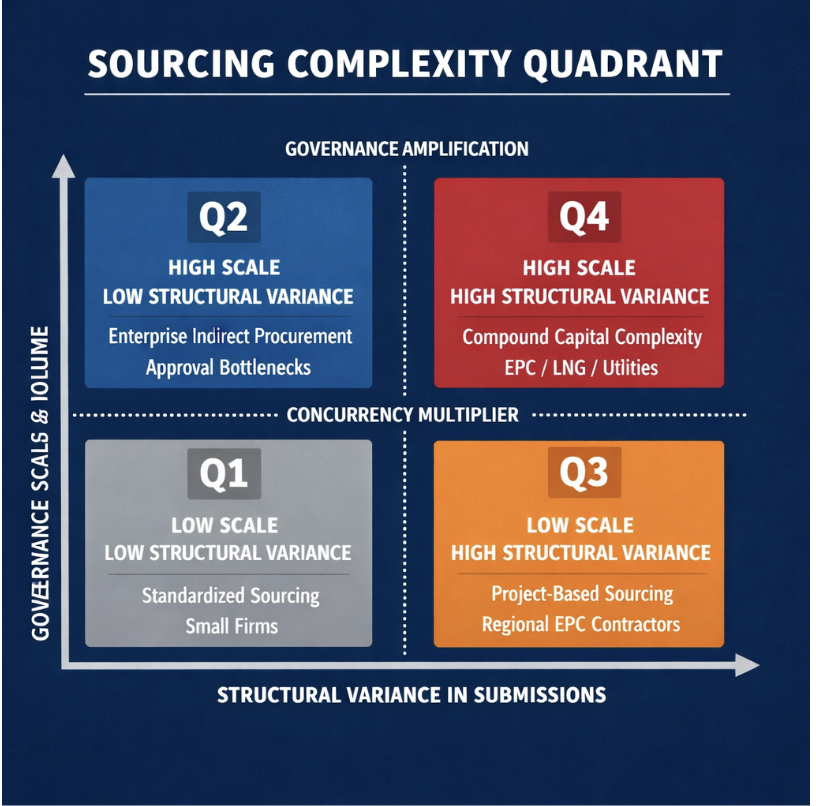
4.1 Quadrant Definitions
Quadrant 1: Low Scale, Low Structural Variance
Standardized procurement environments.
Example: Mid-sized firm sourcing catalog components.
Primary risk: Administrative inefficiency.
Quadrant 2: High Scale, Low Structural Variance
Enterprise indirect procurement.
Example: Global consumer goods organization sourcing standardized materials.
Primary risk: Approval bottlenecks and policy enforcement strain.
Quadrant 3: Low Scale, High Structural Variance
Project-driven sourcing environments.
Example: Regional EPC contractor with limited concurrency.
Primary risk: Manual normalization overhead.
Quadrant 4: High Scale, High Structural Variance
Compound capital complexity.
Example: Global EPC, LNG operator, or utility managing concurrent capital programs.
Primary risk: Structural strain compounded by governance amplification.
4.2 The Concurrency Multiplier
Structural complexity behaves differently under concurrency: while manual normalization is time-intensive but stable at low concurrency, structural variance compounds across sourcing packages at high concurrency, introducing a concurrency multiplier.
Concurrency Multiplier Model
| Concurrency Level | Normalization Stability | Evaluation Cycle Impact |
|---|---|---|
| 1–2 active packages | Stable | Predictable |
| 3–4 active packages | Strained | Extended |
| 5+ active packages | Bottlenecked | Non-linear expansion |
Compound complexity emerges when governance scale intersects with high concurrency and structural variance.
This is the operational environment of global capital programs.
4.3 Governance Amplification Effect
Governance layers amplify structural strain. The more stakeholders involved, the more structural clarity is required.
Without normalization:
-
Stakeholders re-interpret vendor submissions independently.
-
Clarification loops multiply.
-
Award defensibility weakens.
When all three variables are high, sourcing strain accelerates. Compound complexity is not simply additive; it is multiplicative, calculated by considering structural variance, governance scale, and concurrency. When all three of these variables are high, the resulting sourcing strain accelerates significantly.
5. Capital Risk Propagation
Structural ambiguity does not remain localized within procurement. It propagates downstream.
Risk Propagation Sequence
-
Misaligned comparison
-
Award based on incomplete scope
-
Post-award clarification
-
Change order issuance
-
Budget reallocation
-
Schedule compression
-
Margin erosion
Capital projects are particularly sensitive to structural misalignment because financial exposure is magnified. A minor scope misinterpretation in a capital equipment package can cascade into schedule delay, labor rescheduling, and contractual dispute. Structural clarity reduces propagation. Governance alone does not.
6. EPC Deep Dive: Structural Complexity Under Capital Pressure
Engineering, Procurement, and Construction environments provide the clearest illustration of compound sourcing complexity.
EPC organizations operate at the intersection of:
-
High capital intensity
-
Interpretive vendor submissions
-
Multi-phase delivery schedules
-
Cross-functional evaluation
-
Escalating governance expectations
Structural variance is not incidental in EPC sourcing. It is inherent.
6.1 Baseline EPC Environment
A typical EPC sourcing event for engineered equipment may involve:
-
Custom technical specifications
-
Performance tolerances
-
Installation support
-
Commissioning services
-
Long-lead manufacturing components
-
Milestone-driven delivery requirements
Even when price totals appear comparable, structural differences distort the comparison. Each vendor interprets the specification uniquely: some bundle sub-assemblies while others separate them, installation may be implicitly included or priced separately, and risk is managed differently, with some vendors embedding contingency while others externalize risk in assumptions.
6.2 Structural Distortion in Practice
Consider a simplified example where three vendors respond to a pump package RFQ: Vendor A bundles the electrical integration into their core pricing, Vendor B lists it as an optional add-on, and Vendor C assumes the client will supply the integration.
Without normalization:
-
Vendor C appears lowest cost.
-
Vendor A appears mid-range.
-
Vendor B appears highest.
After structural alignment:
-
Vendor A becomes lowest all-in cost.
-
Vendor C becomes highest after adding integration.
-
Vendor B becomes mid-range.
The ranking reverses — a structural distortion that occurs before governance review begins.
6.3 Evaluation Cycle Inflation
When structural ambiguity is unresolved, evaluation cycles expand.
Evaluation Inflation Model
| Structural Variance Level | Clarification Rounds | Cycle Time Impact |
|---|---|---|
| Low | 1–2 | Baseline |
| Moderate | 3–4 | +25–40% |
| High | 5+ | +50–100% |
In high-concurrency environments, clarification cycles overlap across packages, compounding delay.
Extended evaluation cycles create schedule compression downstream.
Schedule compression increases:
-
Overtime labor
-
Expedited shipping
-
Rework costs
Structural sourcing complexity becomes capital cost inflation.
6.4 Margin Compression Effect
Capital project margins are often narrow. A 2–3% margin erosion can significantly impact profitability.
Structural sourcing ambiguity contributes to:
-
Change order exposure
-
Scope disputes
-
Mispriced awards
-
Budget reallocation
-
Delayed milestone billing
Margin Compression Pathway
| Structural Ambiguity | Financial Impact |
|---|---|
| Hidden exclusions | Unplanned scope additions |
| Embedded contingency | Inflated capital allocation |
| Misaligned delivery | Schedule penalties |
| Evaluation delay | Lost opportunity cost |
Compound structural complexity incrementally erodes margin, and while this erosion is rarely attributed to the sourcing architecture, it should be.
7. LNG and Transmission & Distribution Variations
While EPC provides a clear case, LNG and T&D environments exhibit structural complexity in distinct ways.
7.1 LNG: Modular Fabrication Complexity
LNG projects often involve:
-
Modular fabrication yards
-
Specialized cryogenic equipment
-
Multi-stage commissioning
-
Long-lead turbine packages
Structural variance appears in:
-
Module grouping differences
-
Commissioning inclusion variance
-
Contingency allocation
-
Freight and installation assumptions
LNG procurement frequently spans international fabrication environments, increasing concurrency and governance layers. Structural ambiguity in LNG sourcing can propagate into offshore integration delays, compounding financial exposure.
7.2 Transmission & Distribution: Long-Lead Asset Complexity
Transmission and Distribution modernization projects often include:
-
Transformers
-
Switchgear
-
Protection systems
-
Grid automation components
Structural sourcing complexity manifests in:
-
Technical configuration options
-
Performance tolerances
-
Integration assumptions
Structural clarity is critical in T&D environments where grid reliability and regulatory scrutiny are high. Long-lead equipment increases exposure to structural misalignment — if scope is misinterpreted early, downstream schedule delays may stretch across quarters.
8. Quantifying Structural Sourcing Risk
Structural sourcing complexity is often perceived as qualitative. It is quantifiable.
8.1 Clarification Loop Modeling
Each additional clarification round adds time. If one clarification cycle adds five business days, and five cycles occur, evaluation extends by twenty-five business days. Across five concurrent sourcing packages, that becomes 125 business days of additional evaluation load. This is not theoretical. It is observable in high-variance environments.
8.2 Change Order Exposure Modeling
Industry data often shows that 5–15% of capital project costs are affected by change orders. Not all change orders originate in sourcing ambiguity. However, a meaningful portion are traceable to:
-
Scope exclusions
-
Assumption misalignment
-
Structural comparison distortion
Reducing structural ambiguity upstream reduces downstream change exposure.
8.3 Schedule Compression Multiplier
Extended evaluation cycles compress project execution windows.
Compressed execution windows increase:
-
Overtime labor
-
Expedited procurement
-
Coordination errors
The schedule compression multiplier is often invisible in sourcing discussions. It should be central. Structural clarity at sourcing reduces schedule compression later.
8.4 Capital Predictability Impact
Capital-intensive organizations are judged by predictability.
Investors and boards prioritize:
-
On-time delivery
-
On-budget execution
-
Margin stability
Structural sourcing ambiguity undermines predictability. Normalization capability strengthens it. This shifts sourcing from administrative function to strategic capital lever.
9. Designing for Structural Clarity
If structural sourcing complexity is the core strain in capital project environments, the response must be architectural rather than procedural.
Incremental fixes do not resolve structural ambiguity. Adding more approvals does not align vendor submissions. Increasing documentation requirements does not normalize line items. Expanding procurement headcount does not eliminate variance in scope interpretation.
Structural clarity must be engineered into the sourcing lifecycle.
9.1 The Structural Response Model
A capital-ready sourcing architecture should include six integrated layers:
-
Structured Intake Layer
-
Assumption Capture Layer
-
Vendor Submission Normalization Layer
-
Technical Evaluation Layer
-
Commercial Evaluation Layer
-
Governance and Traceability Layer
Each layer builds on the previous one: Normalization precedes evaluation, evaluation precedes governance, and governance ultimately rests on structurally aligned inputs.
Layer 1: Structured Intake
Capital project sourcing begins with technical specification capture.
Structured intake ensures:
-
Explicit scope boundaries
-
Clear performance tolerances
-
Defined inclusion and exclusion criteria
-
Identified optional components
When intake is ambiguous, vendor interpretation expands. Structured intake reduces interpretive divergence.
Layer 2: Assumption Capture
Vendors embed assumptions in submissions. These assumptions must be surfaced explicitly rather than buried in attachments or footnotes.
Assumption capture enables:
-
Transparent comparison
-
Early risk identification
-
Stakeholder alignment
Hidden assumptions are a primary driver of downstream change orders.
Layer 3: Vendor Submission Normalization
Normalization aligns vendor structures into a comparable framework.
This includes:
-
Standardized line-item mapping
-
Consistent scope grouping
-
Transparent contingency identification
-
Delivery schedule alignment
Normalization converts heterogeneous submissions into structurally aligned inputs. Without it, comparisons are distorted. With it, evaluation becomes defensible.
Layer 4: Technical Evaluation Separation
Technical evaluation should be decoupled from commercial ranking.
Engineering teams assess:
-
Performance compliance
-
Specification fidelity
-
Risk exposure
Commercial evaluation should only proceed after technical compliance is structurally confirmed. This separation prevents cost bias from overriding structural misalignment.
Layer 5: Commercial Evaluation
Once submissions are normalized and technically validated, commercial evaluation can proceed transparently.
Aligned structures enable:
-
True cost comparison
-
Lifecycle cost assessment
-
Risk-adjusted evaluation
Structural clarity transforms commercial comparison from debate to analysis.
Layer 6: Governance and Traceability
Governance layers operate effectively when structural clarity exists.
Integrated traceability ensures:
-
Assumption documentation
-
Decision defensibility
-
Audit readiness
-
Post-award transparency
Governance built on normalized inputs strengthens accountability rather than amplifying ambiguity.
10. From Administrative Procurement to Structural Capability
Traditional procurement platforms prioritize workflow and compliance. Capital-intensive industries require structural capability in addition to governance control.
Structural capability includes:
-
RFQ structuring
-
Line-item normalization
-
Assumption transparency
-
Cross-functional visibility
-
Comparison defensibility
This capability shifts procurement from administrative coordination to strategic capital orchestration. Organizations that build structural capability reduce reliance on manual bid leveling and ad hoc spreadsheet reconciliation.
The benefits of this approach are reduced evaluation cycles and change-order exposure, leading to increased capital predictability.
11. Strategic Implications for Capital Project Leaders
The implications extend beyond procurement.
Structural sourcing clarity impacts:
-
Margin defense
-
Project predictability
-
Stakeholder confidence
-
Competitive positioning
Capital project leaders who institutionalize normalization gain:
-
Faster award decisions
-
Reduced clarification loops
-
Lower downstream dispute risk
-
Stronger board-level predictability
Structural sourcing clarity becomes a competitive differentiator. In industries where capital efficiency determines market leadership, sourcing architecture becomes strategy.
12. The Shift in Competitive Advantage
Historically, competitive advantage in capital projects was driven by:
-
Engineering expertise
-
Labor efficiency
-
Vendor relationships
Increasingly, it is influenced by:
-
Structural clarity
-
Decision velocity
-
Capital predictability
-
Normalization capability
Organizations that continue to treat structural sourcing ambiguity as a manageable inconvenience will experience increasing strain as concurrency rises.
Organizations that redesign sourcing architecture to absorb structural variance will outperform. The shift is subtle but decisive.
13. Conclusion: Complexity Must Be Designed Around
Sourcing complexity is an inherent feature of capital-intensive industries. This structural complexity arises from subjective vendor proposals, multiple layers of governance, and decentralized stakeholder evaluations.
To overcome this, capital project procurement must integrate both normalized processes and accountable governance. Relying solely on administrative tools is insufficient to manage this structural variability. Uncontrolled governance merely increases friction, while normalization without oversight lacks accountability.
The future of sourcing in sectors like EPC, LNG, Transmission and Distribution, and complex manufacturing hinges on achieving structural clarity. This clarity doesn’t eliminate complexity; it converts it into a manageable system architecture.
Organizations that proactively design for structural clarity can transform sourcing from an administrative burden into a source of strategic leverage. Conversely, those that fail to do so will find that increasing project concurrency only compounds complexity.
The true impact will not be apparent in policy documents, but in core performance indicators: margins, schedules, and predictability. Developing a structural sourcing capability is therefore no longer optional for capital-intensive industries—it is a foundational requirement.